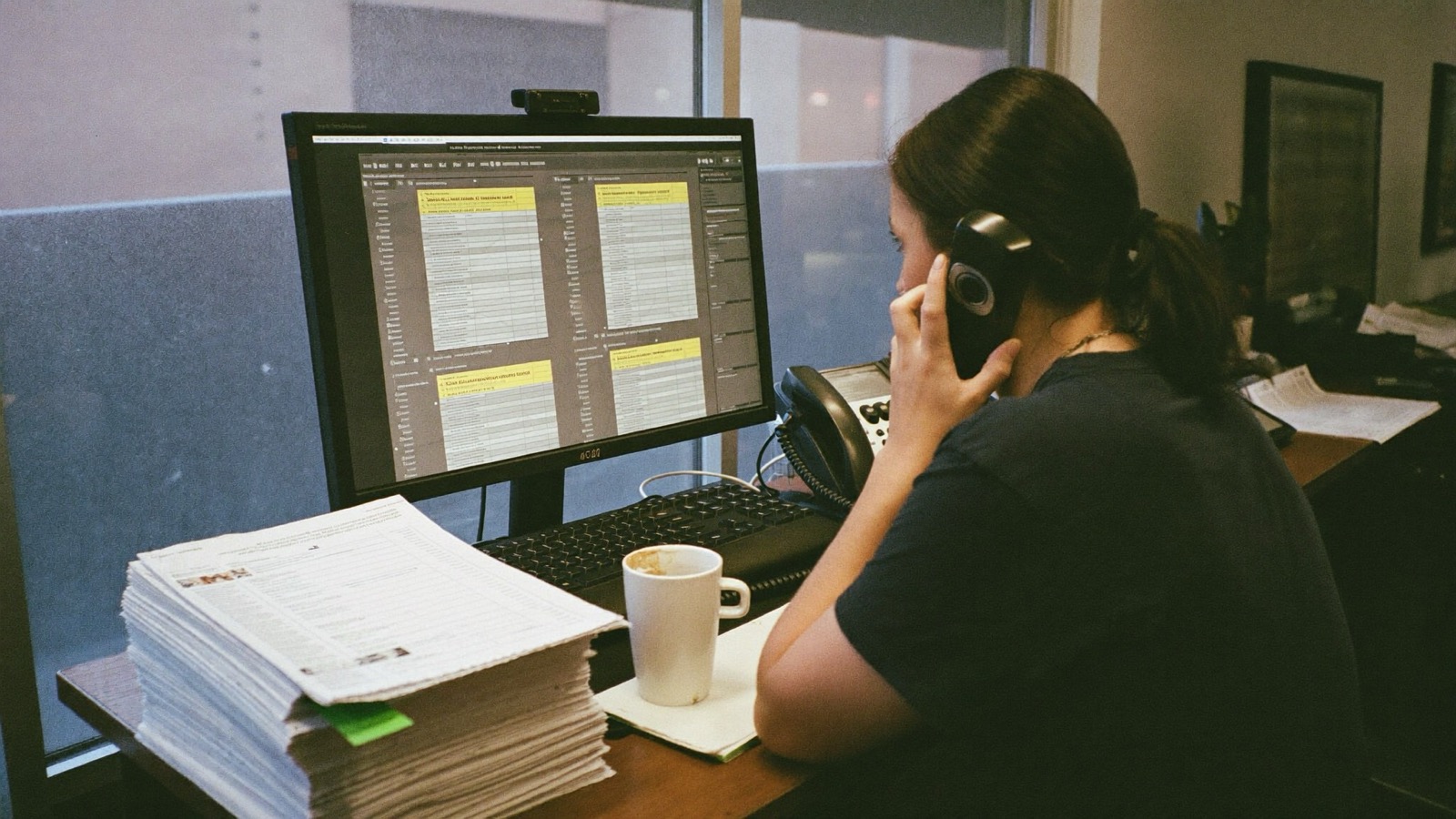
Most operators we talk to aren't asking "should we use AI in hiring." They're past that. What they're actually asking, usually on the second call once the sales pitch is over, is narrower and harder: which part of this can a machine touch, and which part has to stay a person's call. Get that wrong in one direction and you're still paying five recruiters to dial numbers all day. Get it wrong in the other direction and you've auto-rejected a good candidate on a keyword, or worse, built something a regulator now has questions about.
The numbers say the industry is stuck exactly there. Almost every firm has tried AI. Very few have let it into the workflow.
Here's where we've landed after building this inside real staffing operations, not demoing it at a conference.
Automate the contact. Never automate the verdict.
Screening is the highest-volume, lowest-differentiated work in a staffing operation. Dial, no answer, dial again, ask the same six qualifying questions, discover the candidate has no right-to-work document, log a note, move to the next name.
A recruiter who spends 60% of the day on unanswered dials is a recruiter who isn't talking to clients.
That part automates cleanly. Multilingual voice and WhatsApp agents can call every applicant within minutes of an application landing, run your gates (shift availability, travel time, licence status, language level), and hand a recruiter a structured, qualified result instead of a stack of unanswered dials. In the operations we've built this into, time-to-hire has dropped by roughly 60%.
What doesn't automate is the decision underneath it. The agent gathers and verifies answers. A person decides what happens to someone who fails a gate. That isn't a compliance nicety added for legal cover. It's the actual design, because the alternative is a keyword rule silently filtering out a candidate who was one clarifying question away from qualifying.
Adoption is wide. Depth is not.
Share of staffing firms by how far AI has reached into the operation
Source: Bullhorn GRID 2026 Industry Trends Report.2 Bars share one scale; the lighter bar is the prior-year figure.
Automate the reminder. Never automate the reason someone stops answering.
The same split shows up downstream, in confirmations and interview scheduling. A timed WhatsApp or voice reminder, sent when the worker actually reads messages rather than in one nightly blast, is a scheduling tool. It doesn't need a person watching it fire.
But when a candidate stops responding, goes quiet after three reminders, cancels twice, or gives an answer that doesn't match their application, that's not a scheduling event anymore. That's a person who needs a recruiter to actually call them and find out why. Automating past that point doesn't save time. It just moves the cost from recruiter minutes to a candidate you lost and never found out why.
Automate the paperwork trail. Never skip the consent it depends on.
This is the one operators get bitten by first, usually without meaning to. The rules are not vague any more, and the dates are already on the calendar.
- 8 Feb 2024US: an AI voice is an "artificial voice" under the TCPA
The FCC's declaratory ruling puts AI-generated voice calls under the same prior-express-consent rule as any robocall. Fine for applicants who gave their number through a proper disclosure. A real liability for a cold list.3
- 2 Aug 2026EU: transparency duties under the AI Act
Article 50 obligations, including telling people when they are interacting with an AI system, apply on the original schedule.4
- 2 Dec 2026EU: algorithmic management rules for platform work
Member states must transpose the Platform Work Directive: decision logs, human review, and worker-facing disclosure for automated decisions.5
- 2 Dec 2027EU: high-risk obligations for AI in employment
The Annex III deadline moved from August 2026 to December 2027 under the Digital Omnibus, approved 29 June 2026. Employment and worker-management systems are on that list.4
None of that is a reason to slow down. It's a reason to build consent capture and decision logging into the workflow on day one instead of retrofitting it after a candidate complains. The firms who get burned aren't the ones automating screening. They're the ones who automated it without an audit trail, because nobody thought to ask what a regulator would want to see six months later.
Where it broke
We've watched voice agents fail in exactly the ways you'd expect: noisy lines, code-switching mid-sentence, an unusual name the model mishears twice in a row. Early on we let the agent guess and hoped the transcript would look fine later. It didn't. The fix that held was an escalation threshold that hands the call to a person the moment confidence drops.
The actual rule
The dividing line was never "how much of hiring can AI do." It's simpler than that, and most of the confusion in that 10% number comes from firms treating it as one decision instead of a dozen small ones.
Automate, with consent and a log
- First-contact calls and messages, in the candidate's language
- Qualifying gates: availability, travel time, licence, right to work
- Interview and shift confirmations, timed to when people actually read
- The paperwork trail: consent capture, decision logs, disclosures
Never automate
- The verdict on a candidate who fails a gate
- Finding out why someone stopped answering
- Rate negotiation with a client
- A disciplinary conversation, or any worker in distress
- First contact for a role where the relationship is the product
Not because the technology can't fake a version of the right-hand column. It can. But a candidate or a client who realises they were talking to a script instead of a person doesn't come back. A staffing firm's entire business is being the people who show up when it's hard, not the ones who script around it.
The AI should decide who gets a callback. A person should always decide who gets a no.The rule, in one line
Not sure which side of the line your workflow sits on?
Bring your screening volumes, gate criteria and where candidates currently fall through. In thirty minutes we'll tell you what to automate first, and what to leave alone.
Request a free 30-minute teardown →Sources
- Professional Background Screening Association with HR.com, annual employer screening survey: 96% of US employers conduct background screening before hiring. Summarised at S2Verify and Reliable Background Screening.
- Bullhorn, GRID 2026 Industry Trends Report and press release, 25 February 2026: 10% of firms have AI embedded throughout the workflow; 29% still experimenting (56% a year earlier); 30% moved to agentic AI; top performers four times more likely to use AI.
- Federal Communications Commission, Declaratory Ruling FCC 24-17, 8 February 2024.
- Council of the European Union, Digital Omnibus, final approval 29 June 2026. Summaries from Morgan Lewis and Travers Smith: Annex III high-risk deadline moved to 2 December 2027; Article 50 transparency obligations unchanged at 2 August 2026.
- Directive (EU) 2024/2831 on improving working conditions in platform work; transposition deadline 2 December 2026. See our summary.